I am just putting a few notes here, in case of interest to anybody. The original book is in French, by Anny-Dominique Curtius. It is a very thorough analysis of the fragments of Suzanne Césaire‘s (1915-1966) work and life, aptly named an ‘archaeology’. I mainly read the book for Curtius’ identification of a ‘liana dialectic’ in Césaire’s work, however, the remainder of the book was also very insightful. Curtius is good at illustrating scale of exoticisation, sexism and colourism that she had to endure from all sides, from male white intellectuals to fellow Martinican women. One quote by Michel Leiris still sticks in my mind, in which he expresses his outrage about her communist activities while being a mother of six children. In case you are not familiar with Césaire’s work, she wrote a series of essays in her 20s that were published in a Martinican surrealist journal called Tropiques. The journal’s purpose was to undermine colonialism, fascism and black assimilation. This was difficult, as its content had to pass the censor in wartime Martinique. Many references are therefore concealed, which can make her work difficult to interpret. Aside from these essays, people don’t know how much else she wrote, apart from one play called Aurore de la liberté. The manuscript is considered lost, though a few interviews with actors helped get a sense of its content.
From her archaeological investigation, Curtius concludes that Suzanne Césaire traces one image or concept through her essays, embodied by the liana. She compares it to Kamau Braithwaite‘s tidalectics, as both concepts challenge the European dialectic imagination. Césaire’s liana dialectic is driven by the necessity to disrupt the aesthetics that sustain social and economic oppression. It is designed as a specifically Caribbean analytical lens that works towards mental and material emancipation. As Curtius puts it, this lens is shaped by Césaire’s attention to the Caribbean’s ‘geologic, historical, anthropological, political and socio-economic multiplicities.’ It is interesting that Césaire even mentions future ecological disasters resulting from the colonial economy. In practice, Suzanne Césaire used her many descriptions of Martinican and also Haitian landscapes to subvert colonial and patriarchal stereotypes. Given Césaire’s insistence on the interconnection of struggles, Curtius also compares ‘liana dialectics’ to ‘intersectionality‘. In the final chapter of the book, Curtius draws out six characteristics of ‘liana dialectics’, which I will attempt to summarise here (corrections welcome!):
Image: F. Lamiot, Wikipedia. Lianas in Guyana.
Multisubjectivity: Suzanne Césaire expands geography and not only portrays the Caribbean landscape as agentive, but also uses surrealist auto-ethnography that intertwines self and surroundings.
‘Savage emancipation’ from colonial violence: This involves flipping the script on routine racist imagery, for example that of the cannibal, which Césaire re-appropriates. Curtius describes this method as ‘deterritorialising the practices of representing alterity’.
Aesthetic dissidence: Curtius compares Césaire with the French ‘zutistes’, but argues that Césaire’s project had a wider scope. She also did not underestimate the energies it would take to dismantle the enormous ‘camouflage’ that aesthetically conceals the horrors of colonialism, and racial and patriarchal oppression. She recognised its many, deeply internalised manifestations, the ‘collective lie’ that holds it in place.
Fight for political and economic agency. Here Curtius draws attention not only to the liana, but also the morne, a landscape feature that could be translated as an island relief or hill: ‘The morne is a place where social cataclysms, ecological disequilibria, land dispossession, political and cultural consciousness, and female agency intertwine.’ She also points out that Césaire was driven by the question of what an emancipated Caribbean civilisation could look like.
Liberatory eco socialities: Suzanne Césaire is invested in the assertion or awakening of subaltern agency. She experiments with (feminine) ‘geo-corporeality’ that aims at the deconstruction of the binaries ‘woman-nature-fertility-subalternity’ and ‘man-culture-reason-power’. Her ‘eco feminism’ also aims for emancipation from the trauma of slavery and from the continuation of plantation hierarchies (reflected, for example, in her attention to Martinican rituals of African origin). Again, she stresses that multidimensionality needs asserting.
Mental and aesthetic revolution: I think this is something that can still be felt across the world today, with culture wars going on between the colonial, patriarchal world view and a direction that seeks freedrom from it. Especially when economic tools are lacking – who can keep up with the financial power of reactionary billionnaires? – the one thing that people can do is change minds and images.
While reading these points, I had to think of Césaire’s method of dropping (images of) European theorists into the Caribbean language, to show how their theories struggle against, or in some cases even shatter, in the environment of the Caribbean. Her essay ‘Malaise of a Civlisation’, a critique of Freud’s ‘Civilisation and Its Discontents’ is a great example of this method. I prefer her method to Dipesh Chakrabarty’s ‘provincialisation’ of knowledge, due to his uncritical use of Heidegger to contest universality. There are currently too many examples, where Marx is being criticised for being unsuitable for [insert region or context], while far right thinkers are being adopted without any critical discussion of their racism, sexism etc. I guess, as a geographer, I like Suzanne’s Césaire’s emphasis on movement. Knowledge travels, and there is a choice of acknowledging what happens during such a journey. One of the questions that came out of her work for me is what to do with all those Caribbeanised and otherwise transformed European thinkers after their return from their troublesome journeys.
I am not sure if I would call Césaire’s method ‘liana dialectics’, but I find it interesting as a proposal. I have always struggled to understand the fuss over ‘ordinary’ dialectics, so I am not sure why we need dialectics at all, but I can get why you would want to trouble them. As a geographer, what also springs to mind is the current advice to cut mangroves as a ‘climate solution‘. While lianas can have beneficial as well as harmful effects on their hosts, their proliferation is seen as bad because of their impact on tree growth and timber production. More growth and more timber = more carbon taken out of the atmosphere, or so the current ‘green’ economic thinking goes. Ironically, excessive liana ‘infestations’ are often portrayed as a consequence of colonial forest mangagement that needs rectifying through a more caring capitalism. Here, liana dialectics are even more apt, as obstacles to ‘green capitalism’ and its continued plantation economy. I particularly like the image of the liana holding onto the tree, trying to make it less productive, even if this means absorbing less carbon, to prevent an entire planet from being strangulated by business as usual. Again, it is a ‘camouflage’ that is offered instead of a solution.
I have been invited to participate in a panel at the Constitutionalizing in the Anthropocene research week (you can find the entire programme here). The panel is called ‘The inhuman as capital’, where I will be in conversation with Adam Bobbette and Julia Dehm. There has been a bit of an email exchange before the panel, and it sounds like the different directions from which we are coming might be quite interesting in complicating the theme. I have actually been writing a chapter on economics as part of my book, so thought it might be a good opportunity to ‘field test’ some of the ideas. The chapter is currently titled ‘Marx’s dogs’ (it started off as ‘we have never been social’). It has become a bit of a satirical take on Donna Haraway’s criticism of Marx in her writing on dogs. By looking at Marx’ own dogs, his commentary on dog taxation, dog tax riots, and dog taxation as a colonial tool, I am questioning avoidance of the economic within new materialism. Although many new materialist authors are talking about ‘socialising the nonhuman’, economics rarely seem to be part of the social. Marx, in particular, has become a bit of an odd enemy figure, given the many possible enemies that new materialism should have, but seems to uncritically embrace despite their politics (Nietzsche, Schmitt, Heidegger, etc). This tendency is especially worrying considering that authors such as Haraway originally began their theoretical journey with anti-capitalist critiques, and considering that there are many smart critiques of Marx that draw out more important issues with his work (e.g. see Unpayable Debt by Denise Ferreira da Silva).
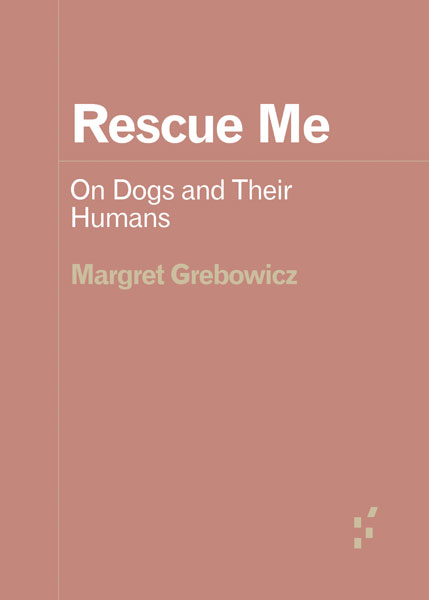
Towards the end of writing my chapter, I came across a neat little book (about 80 pages) that also makes an argument about dogs and economics. The book is called Rescue Me and is authored by Margret Grebowicz. Like Haraway, Grebowicz focuses on dog ownership, however, she ends up in quite a different place. I picked up my copy at the ICA after a ceasefire demo and, at first, the premise of the book seemed rather frivolous given the depressing circumstances. However, Grebowicz ends up making a rather profound argument about reflections on the nonhuman and how they can prompt a rethinking of human-nonhuman socialities (it made me think, for example, of the intensely discussed images of pets in Gaza). Especially at times where it feels as if academic discourse does not have much to say – the association of publication numbers with job security certainly does not help – it is nice to find pieces that convey a message without too much posturing. In fact, the focus is on today’s economic pressures and how they shape relations. The narrative – both in content and style – felt like a much needed antidote to new materialist blindspots.
I am now curious how the research week will go, and which directions people are coming from. I am particularly looking forward to the part on pedagogy. More in a few weeks!
I have just returned from the second instalment of the PEFR conference. I was there to present a paper on left-to-far-right transitions, and to run a zine making workshop with Miranda Iossifidis from Newcastle University. Two colleagues from Media, Samuel Nicholes and Bernhard Forchtner, were also presenting. I already had a telling encounter on the way to the conference when I ran into a market research person, a nice middle aged blonde lady, who turned out to be a fan of racist author Douglas Murray.
Like last time, PEFR (sometimes mistakenly abbreviated as ‘PERF’) took part in a Swedish city – this time in Uppsala. It was nice to trudge through piles of snow and then enter well insulated buildings, which I wish we had in the UK. The conference atmosphere was quite informal and included evening entertainment (there was even a pub quiz that highlighted the absurdity of far-right symbolism around the world!). Attendees came from a variety of backgrounds, including academia, government/policy, journalism and NGOs. Some academics who presented did not actually work on the topic but presented on their activism. In a commitment to environmentalism, many had travelled long distances by train and been delayed by strikes and other issues on the line with some participants experiencing journeys of 20+ hours that normally take half as long. I was also pretty wired from lack of sleep, though mainly due to noisy hotel room neighbours.
Despite the sleep deprivation, I learned a lot during this conference – not just about topics but also about past and present institutional landscapes that deal with the far right and the environment. There were people from the Rosa Luxemburg Foundation who offered free books on related subjects, such as homonationalism or climate change. There was FARN, a German government funded NGO against radicalisation in conservationism. Out of curiosity, I attended one of their workshops. It was about völkisch moments that are heavily present in the region that I’m originally from, and their continuation of historic links between organic farming and esotericism (they also ran a second workshop on methods against radicalisation). I learned that young Germans can now do a voluntary ‘ecological year’ instead of the previous military service or social year. One of the presenters had done such an ecological year and ended up with a problematic organic farming organisation whose ethos turned out to have been built on far right ideology. When checking out their website, I found that they also have student dissertations on the subject for download, which I have to show my undergratuates.
This cross institutional countering of the far right became the subject of a panel, which examined the challenges of researching the far right from different positions such as journalism, academia and government. As someone who grew up with a father who was researching the far right from a police perspective, I was familiar with the hostility that researchers encountered (my family underwent periods of police protection). I was less familiar with the many ‘grey areas’ that people had to negotiate, for example, in policy. How do you block or diffuse the influence of individuals, lobby groups, political parties or even far right governments? What happens to antifascist government foundations when the far right is in power? This was illustrated in other panels as well, from local politicians having to judge far right entries in organic farming competitions to creating ‘Trojan horses’ to sneak left wing ideas into right wing policy.
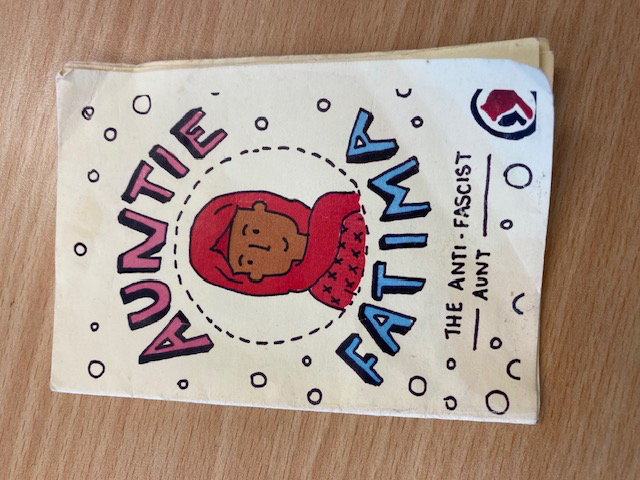
My favourite zine from the workshop, brought to my attention by Miranda Iossifidis (thank you!)
Over the three days, I picked up on some themes that ran across the sessions I attended. One could be described as a far right image change: a PR move that seeks to contradict the perception of the far right as unfeeling, aggressive perpetrators by showing them as empathic, loving, misunderstood victims. Powerpoint slides were littered with images of far right people (usually young men) with cute animals, plants, rainbow flags. This trend appeared in many different countries, including Germany, the US and South Africa. Gender identity and gender relations were also the focus of a psychoanalytic session which heavily drew on the work of Klaus Theweleit with some insightful expansions. One question that was raised in this context was that of ‘grooming’ of young people by older members of the far right. A paper on the Danish ‘Feuerkrieg Division’ showed that young people, predominately young men, can sometimes end up in far right circles simply through peer pressure, and through boredom and lack of perspective. Here, lockdown emerged as an exacerbating factor. This led to another question: ‘What happens when fascists grow up?’
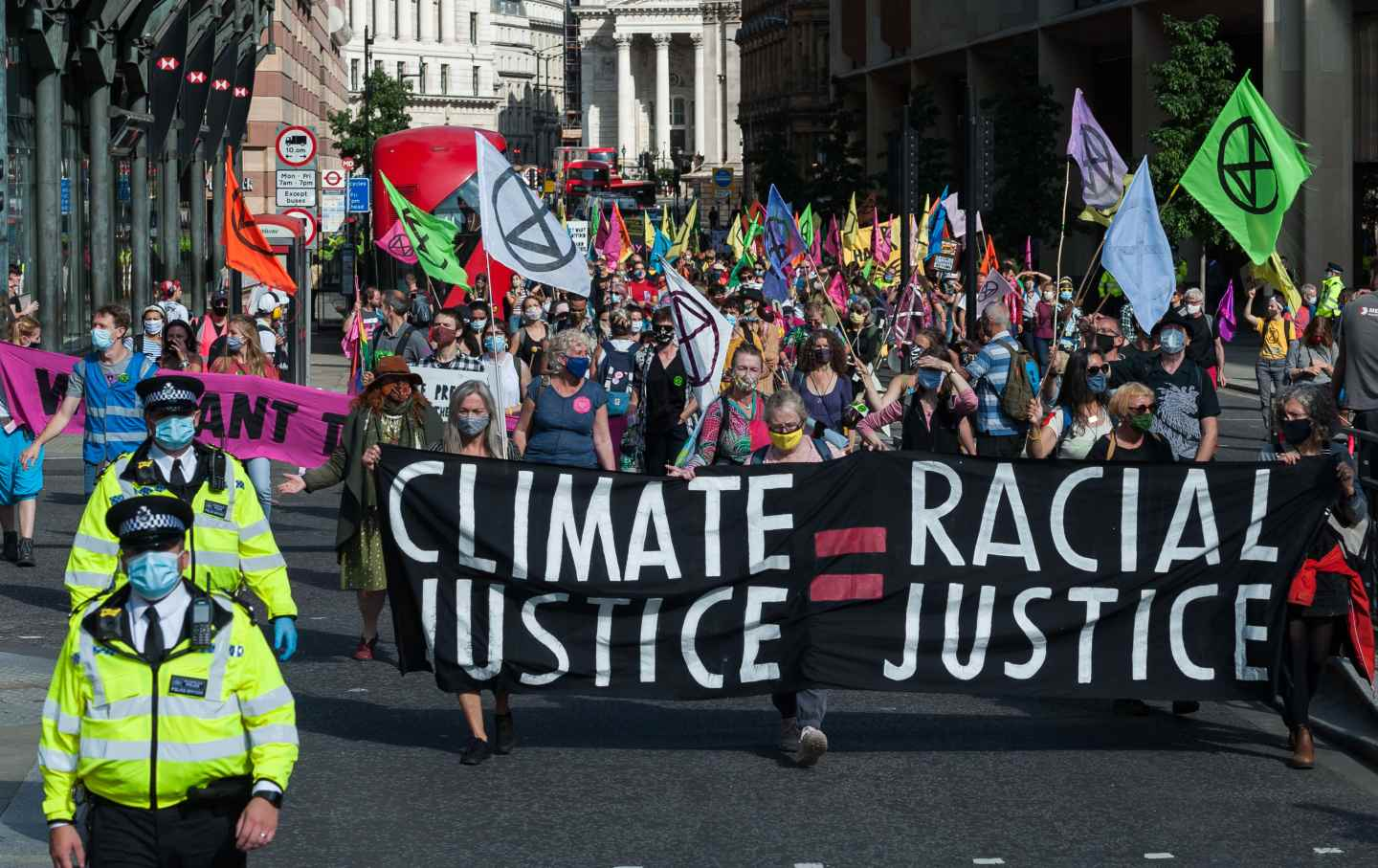
Another focus was left/far right overlaps. Despite my own focus on left-to-far right transitions, I was surprised at some of the left and decolonial appropriations. One striking example was on the French far right’s appropriation of the ‘pluriverse’, normally a decolonial concept, to argue for their own indigeneity and its protection amongst other indigenous groups (great paper by Swetlana von Hindte). The paper was part of a panel on far right arguments for degrowth, which predictably leaned on anti-globalisation sentiments. This rhetoric also showed in various examples of British environmentalism, from Extinction Rebellion groups (‘Sink the boats, save the world’) to ‘Anglofuturists’. Presenter Ada Barbour illustrated this trend with an alarming number of examples that made environmentalism synonymous with opposition to ‘mass migration’.
Extinction Rebellion counter commentary to accusations of racism. Image: Wiktor Szymanowicz / Barcroft Media / Getty.
The most difficult ‘theme’ for me to experience was the tension between antifascist and antiracist approaches. As Jonathan Olsen stressed in his opening keynote, research on ecologies of the far right is heavily influenced by the discourse on Nazi Germany/post-Nazi Germany. While this focus is slowly shifting to other geographical areas and genealogies, this origin still very much shapes the analytical tools of the field as well as the geographical origin of the majority of participants. As someone who normally presents in the context of the UK antiracist discourse, the difference in attendees as well as the non-comprehension of many postcolonial, decolonial or critical race theory concepts was pretty stark. It was also something that I raised during the conference on multiple occasions, because this tension led to absolute gridlocks, intensified by the Gaza conflict.
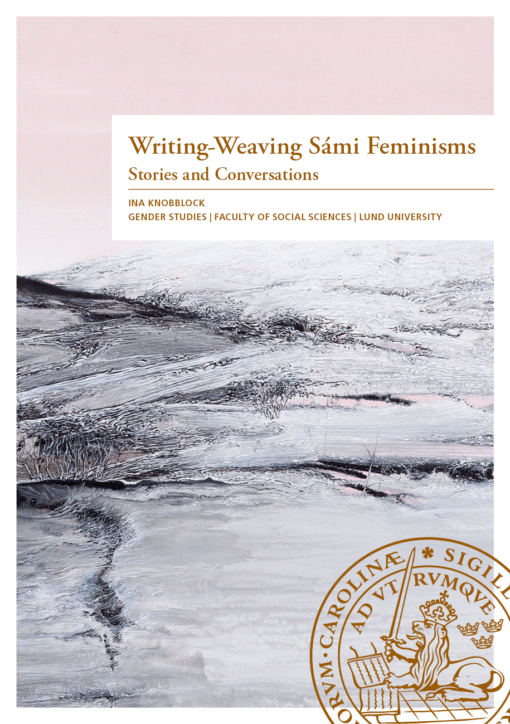
It was not the case that postcolonial concepts were absent. A few antifascist researchers of colour were present, including German ones, and the programme also included papers in which colonialism was central. These included papers from the appropriation of anti-racist and decolonial concepts (e.g. ‘post-development’, ‘pluriverse’, Black Lives Matter) to the ‘saffronisation’ of green energy in India. Further, given the many far right claims to indigeneity, it could be assumed that antifascist researchers would have familiarised themselves with literature on the topic, especially by Indigenous researchers. That this is not the case became apparent during the keynote by Ina Knobblock, a Sami feminist scholar. Three times during the Q&A attendees asked her to distance herself from ‘blood and soil’ ideology. It was very evident that this was something that Knobblock was used to being asked, and visibly tired of being asked. The fact that the question was repeated twice was worrying both in its struggle to contextualise European Indigenous ideas and struggle (forced relocations and residential schools also happened in Europe!) and in its lack of familiarity, by an apparently antiracist audience, with the decolonial discourse overall.
The situation got even worse with the ‘Gaza incident’. It began with one attendee trying to force a statement from Knobblock on the settler colonial situation in Palestine, which was promptly countered by a German participant who insisted that ‘Israel is 100% not a settler colonial state’. This second interaction was problematic in two ways: 1) the initial demand essentially hijacked the speaker’s talk, while assuming generic expertise on all Indigenous issues; 2) the response by the German participant was offensive to many in the audience, especially the few Muslims. This hijacking put others into the position of either speaking up move further away from Knobblock’s concern, or entrenching the trauma for those offended by maintaining silence.
What this incident painfully brought to light was not only the need to address the elephant in the room (Palestine/Israel) but also the blindspots of antifascist researchers. By request of several participants, it led to the spontaneous creation of a workshop, which was timetabled for the following afternoon. While I had also called for a space for discussion, I was apprehensive about a conference workshop, given the strong white German presence at the conference. The German government, media and social media commentary continues to be distressing, with many activists siding with the government line, unlike here in the UK. While I empathise with the fact that German responsibility for the Holocaust needs to inform not just government reactions, but academic reactions, the utter disregard for the colonial and also German nationalist history of Israel (referenced towards the end of this video by David Graeber) is shocking. This blindspot even affects critical Jewish/Israeli voices. Another reason for apprehension was the absence of papers on the Israeli ecocide in the occupied territories at the conference. I first put this down to the fact that researchers working on this topic must feel more comfortable in the postcolonial/decolonial/critical race theory context, but it turned out that there was indeed an accepted paper. The speaker was however not granted a visa by the (far right) Swedish government. In the meantime, the speaker had also lost their entire family in the conflict.
This was the situation in which the workshop took place. Around thirty people arrived at the room, so the group was split in two to enable a less busy discussion. There were two facilitated discussions rounds, one which centred on feelings regarding the topic, and one which focused on analysis. In our group, this did not work particularly well, partly because people were critical of the method (why does anyone need to hear more white people’s feelings?) and partly, because one the aforementioned gridlock. Without going too much into the details, the dynamics felt a lot like a microcosm of the geopolitical situation. Being both German and British, with some Jewish family on my dad’s side, I tried to negotiate between positions, but it did not work. This split was noticeable in other conversations on this topic outside of the workshop. It tended to leave many non-German stunned by a position that maintained that Israel could not be anything but uniformly good. Even though there was empathy for the position that moving even an inch from this position would result in the repetition of the Holocaust, it felt like an intellectual and empathetic failure in face of Israel’s long-term record of atrocities. In fact, Palestinians kept being compared to Nazis who launch pogroms on the Israeli population.
Images: Examples of Jewish organisations who are critical of the Israeli government’s actions in Palestine.
What was even more disturbing was the apparent inability to support the pro-Israel opinion through an academic argument – there was mostly repetition of German antifascist mantras, currently also repeated by the German government. As one participant put it: ‘most people in the West disagree with their governments on this – why not Germans?’ Ironically, this happened in the same breath as denouncing criticisms ‘non-academic’. It was rather harrowing to witness the shock of the German activists who genuinely believed that everyone else had gone over to the dark side, while everyone else believed that Germans were in the process of supporting another genocide. Aside from the refusal to discuss Israel’s links with the British colonial project, there was no acknowledgement of the fact that many far right groups in the UK and Germany are waving and posting Israeli flags. In our workshop, British participants explained that the far right do so not because the far right loves Jewish people, but that either want Jewish people to stay in their own country or support their erasure of Muslim lives. Again, this was seen as equating Israeli with the far right. Likewise, there was no acknowledgment of Jewish protestors experiencing German police violence and other forms of censorship. In fact, this was countered by the claim that there are now ‘no go areas’ for Jewish people in Germany since the conflict. The style of arguing felt more like a psychosis, which is understandable given the apparent collapse of the German antifascist model. All your life you have been trained to make sharp boundaries between good and bad, and now all the usual parameters are under siege.
The reality is that they have been contested for a long time by many Germans of colour, including Jewish voices, but things kept being ignored. This ostrich mode is now just taking on a more surreal form. The sad thing is that denying the very obvious genocidal intent of a far right government is not going to help with the antisemitism problem. It gives the impression that any antiracist action for the left is hypocritical and, like the far right, values one group of people over another. There are killable populations and the left and the far right happen to currently agree on who that is. Needless to say, this tactic can make the situation worse for a lot of Jewish people, including Israelis. It also neglects the fact that violence tends to provoke further violence. As gruesome as the attack on the music festival was, and the hostage situation continues to be, the violence did not come from nowhere. Also, what if geopolitical constellations change?
Despite this unsettling experience, I remain hopeful. There were a few young, quiet Germans who just listened and occasionally nodded when decolonial arguments were made (the German genocides in Namibia were mentioned, for example). I was later approached by attendees, including German attendees, to further explain my position. I appreciated the questions and learned a lot through them. One person said they were not quite clear on the difference between, as they termed it, ‘Antifa versus Antira’. In the final panel of the conference, on the future of the PEFR network, I again raised the issue for further discussion, perhaps in the form of a panel session and a reading list, at the next conference. What definitely needs to happen is to make antifascist spaces safer spaces for BIPOC antifascists. The conference showed that white antifascists need to eduate themselves more about the debates in the wider antiracist discourse, to not end up acting like racists themselves. If racialised people get retraumatised at supposedly anti-racist conferences, this will remain a ‘whites only’ space. As one Muslim participant put it: ‘when I walked into the room, I felt like I was at a conference in the 1940s’. I know that many white antifascists see it as their job to take antiracist work off BIPOCs, but this can become a patronising strategy. If we start from the premise that nothing comes from a bad place, I have some hope that some things can improve. The conference was a reminder that a lot of work still needs to be done, not just in relation to far right groups, but within our own community.
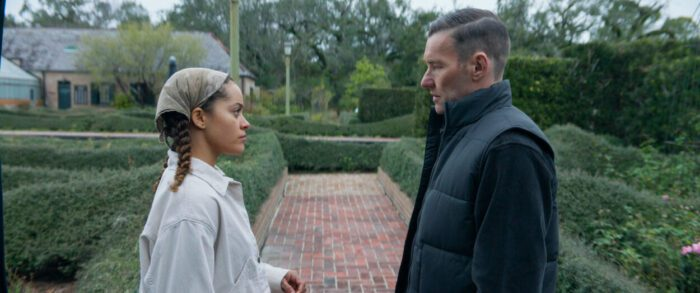
Maya (Quintessa Swindell) and Narvel (Joel Edgerton) visiting a public garden while discussing settler botanist John Bartram and Narvel’s own racist past.
I was not going to watch Master Gardener, because the trailer made it look like a boring action film. But then I wondered whether it might be interesting in relation with my research on ecofascism. In this aspect, the film did not disappoint. When I looked up the film reviews afterwards, critics did not touch on this theme at all. Instead they accused director Paul Schrader of three things: being a ‘one-trick pony’ (focusing on the redemption of troubled men for the last 50 years), using an unrealistic storyline, and off-screen ranting against ‘wokeness’. The film was considered schematic and untimely. I had not watched anything by the director, apart from American Gigolo (1980) many years ago, so I cannot comment on the patterns, but I felt that some of the social observations expressed in Master Gardener were more sharp and subtle than a lot of other well-intentioned white attempts to address racism. Here, I disagree with many critics that the material was in the wrong hands. I also do not agree that the film was boring, or that it had a slow pace (I really needed to go to the toilet during the film, and it was difficult to find a moment where I felt I wouldn’t miss out on an essential part of the film). Rather, it feels as if Schrader addresses some of the power dynamics to which he seems to be oblivious in real life.
Master Gardener is part of a trilogy, together with First Reformed (2017) and The Card Counter (2021), that Schrader describes as ‘men writing a diary’. Like First Reformed, the film takes on the ecology-society relation, though in a different way. Where First Reformed is about a priest who realises that religious organisations have a hand in destroying the planet, Master Gardener is a story about the desire for order, and how ideas about order underly toxic social structures such as racism, sexism, queerphobia etc. The director was apparently inspired by a gardening programme that made him realise that ‘most people think of gardening as life-enhancing, nourishing, beauty-enhancing, but it’s also full of violence – cutting, pruning, weeding, deadheading … Gardening is a kind of eugenics’ (Another Mag). The film starts with the phrase ‘gardening is a belief in the future – a belief that things will unfold according to plan’. This phrase hit me rather hard, given that a close friend – a devoted gardener – had taken his own life the weekend before. The phrase rang untrue, and I felt that the voice of the main character carried a heaviness. He seemed to utter the sentence like a mantra, as if he needed to hold on to this belief.
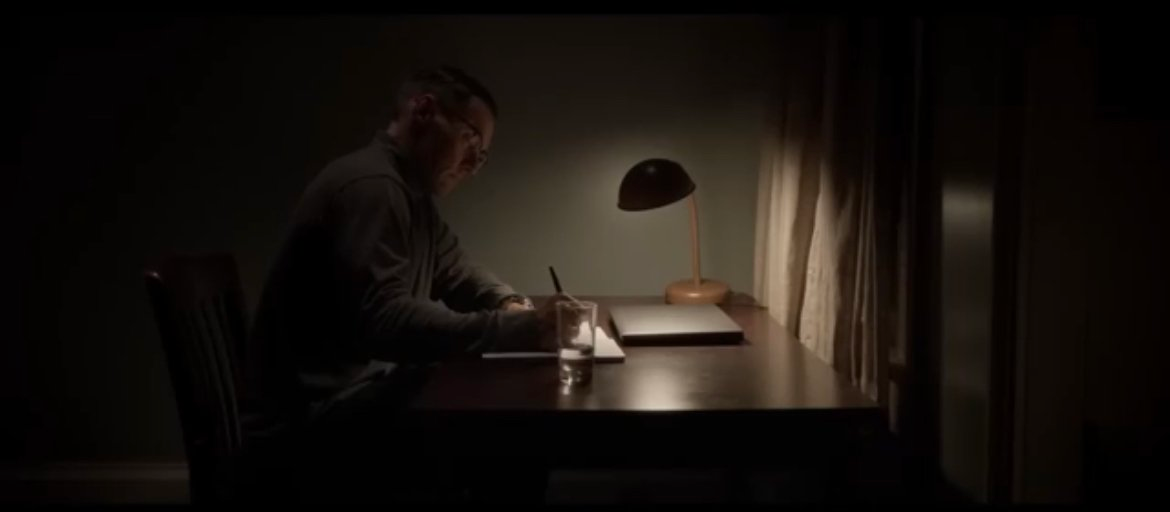
Image: Narvel writing his diary, reflecting mostly on gardening, but increasingly on interpersonal dynamics. There is a later scene where he writes in front of a mirror with his shirt off, his Nazi tattoos becoming visible to Maya.
The setting of the garden is a mansion, owned by the wealthy Norma (Sigourney Weaver). Its style implies that it is a former plantation (the film was shot at Rosedown and Greenwood Plantations). Norma has servants who take care of her, and gardeneres who take care of her formal garden which also functions as a venue for gardening shows. The garden, despite the cameraderie amongst the staff and mundane routines through which it is tended, feels like an uncomfortable environment. The imposition of geometric forms on plant life seems to echo the on-going attachment to inherited slave owner wealth, aesthetics and related power dynamics. The gardener in charge is Narvel Roth (Joel Edgerton), who is introduced as an earnest man who fills his diary with philosophical thoughts about human-nature relations. It is later revealed that he is a former neo-Nazi who went undercover as part of a witness protection programme. The film documents his evolving relation with nature, possibly guided by Norma’s tutelage (they are also lovers). While still a neo-Nazi, Narvel was no stranger to gardening philosophies, believing his group leader that the far right are like a gardeners who ‘pull out the weeds’. In the present, he tries to combine his identification with the ordering drive of European natural history with a holistic narrative about healing. In one scene, for example, he gets his apprentices to smell the soil to connect to the ‘mineral, animal, vegetal’; in another, he mourns that people only connect to the soil with soles and not skin. His commentary hovers between the imagery of ‘blood and soil’ and a transcendence of this attitude, showing the uncomfortable closeness of ideas. It reflects the creepy comfort of racism, through its illusion of tending an otherwise disorientated nature. Narvel’s new routine is disrupted by the arrival of Maya (Quintessa Swindell), Norma’s ‘troubled’ mixed-race grand-niece, who was invited by Norma to start a paid gardening apprenticeship.
On the surface, the plot and some of the stylistic tools feel overly didactic and two-dimensional: the rich woman having an affair with her edgy gardener; rich people performing transactional forms of relation; the ‘expulsion from paradise’ theme; the black relative being a drug addict whom a white woman wants to ‘civilise’; two-dimensional drug dealers and ‘hood’ representations; the drug withdrawal mentorship; the racist being redeemed though his acceptance by and affection for a black woman. These tropes are indeed dumb and outdated, if they were to be realistic. On a metaphorical level, and in combination, they make a lot more sense.
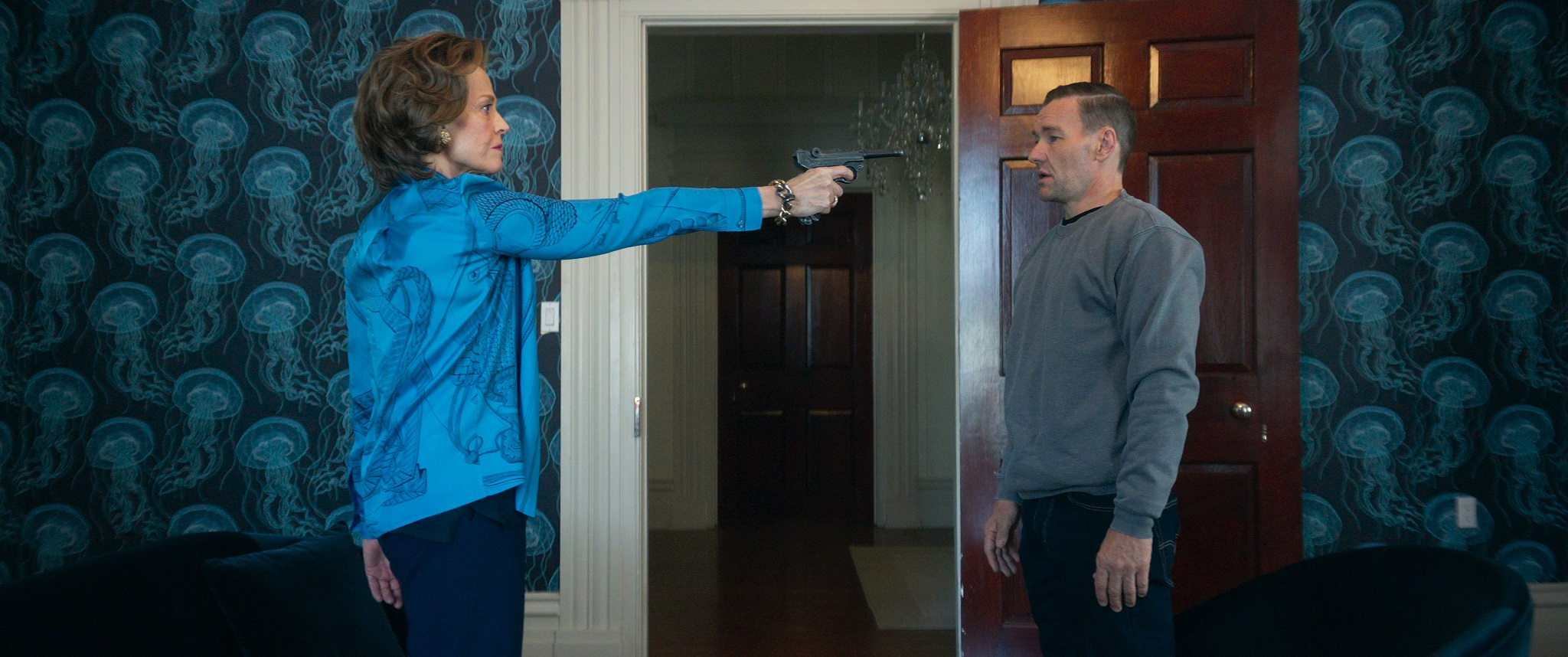
Image: Norma raging at Narvel (note the wallpaper and shirt patterns)
Apart from the soil theme, there are two other images in the film that I appreciated. The first one is the easy-but-uneasy ‘return to the garden’. After suspecting an attraction between Maya and Narvel, the jealous Norma kicks both of them out. Within the same day, the two of them end up on a road trip dealing with both Maya’s and Narvel’s demons (Maya’s addiction and violent home environment; Narvel’s racist/murderous past). After a tense resolution, they return as a couple, but find the garden vandalised by Maya’s former drug dealers. Narvel makes an offer to Norma to get the garden back up for the following year (‘Plants rejuvenate – that’s what they do.’), but under the condition that him and Maya get to stay on the premises as a married couple. Norma grudgingly agrees, and the closing scene shows Maya and Narvel slowly dancing on the porch of Narvel’s former cabin. The image could be interpreted as a ‘return to paradise’, but it actually feels more like a return to another oppressive space, especially with the marriage (= property relation) and cabin imagery thrown in, and the spatial limitations of their dance. Since the ‘outside world’ is portrayed as an even more hostile environment (racism, drugs, dubious policing), married life in the garden perhaps becomes an opportunity, a space where at least some control can be exerted on a hostile environment. There seems no point making an intervention in the world beyond – it seems impossible to succeed against such entrenched dynamics, so the aspiration can only ever be partial containment. The garden thus becomes Maya’s and Narvel’s safe space, without ever having been a safe space for people like Maya (whose dad is African) or even Narvel (by association with Maya) in the past – or without ever truly becoming one in the present (it is more like a contained microcosm of the outside world). The outside world will always crash in, as will natural hazards. As another gardener counters Narvel’s determinist view on ordering: ‘you cannot spreadsheet nature – it will always surprise you’. This is not just in the good sense – Narvel’s transformation against all odds – but also in a portending sense. Here, the film is not actually an optimistic redemption story, as it has been frequently read. The kitsch ‘redemption moment’ – a magical realist rupture featuring flowers blooming in the night – feels far too satirical for that.
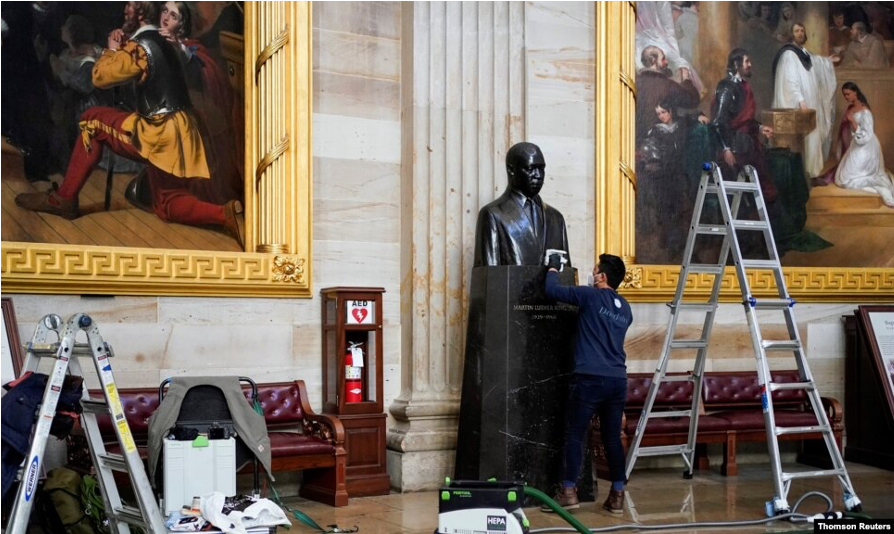
Even Maya’s and Narvel’s relationship feels uncomfortable despite the apparent mutual healing. For me, this is not for obvious reasons such as age difference, race or ‘Lolita’ complex (Narvel has a daughter he can never meet again who could be close to Maya’s age), but for the fact that Maya interacts with Narvel in very much the same way as her great-aunt (intimate scenes with both Norma and Maya carry resonances of slave markets, with the abject Narvel being the one inspected). This leads me to the second image, which I find even more powerful: the intersection of race, racism and class, represented in the Norma-Maya-Narvel triangle. Not only does Maya represent a class ambiguity for many (her mum is considered ‘fallen’ upper class, because of her drug addiction; her dad is not considered upper class, solely because he is Black), but she deliberately performs these ambiguities with different people (e.g. passing for upper class to get drugs to wealthy clients, passing as poor in a poor neighbourhood, though ultimately breaking with this environment at the end). Class also matters in the racism performed by Narvel and by Norma. While Narvel and his friends are the obvious racists or ex-racists, the wealthy or middle class white people in the film make ‘acceptable’ racist assumptions, and continue to uphold and benefit from racist infrastructure. As in real life, everyone’s eyes are on the raging people of the Capitol Riot, but not on the colonial paintings that surrounded them in the building – the acceptable racism of official genocide. Even when media commentary focuses on the Black and Latino workers who cleaned up the mess, the fact that the structure itself is infused with racism, and thus enabling the comfort of Nazis within the structure, is carefully ignored. In the film, this quiet racism is also represented through visual details: the jellyfish wallpaper on Norma’s mansion walls that echo the drawings of German eugenicist naturalist Ernst Haeckel, Norma’s shirt pattern depicting sailing ropes and anchor prints.
If one looks back at the anti-woke comments by the director, one might also wonder about a potential commentary on white Americans feeling disenfranchised by a rising Black middle/upper class that has a growing influence on US and global culture. In the past, such anxieties have led to horrific events such as the Tulsa Race Massacre in 1921. At the 100th anniversary commemorations of the event, speakers drew troubling parallels with the present. In the film, it is not just Narvel’s past self that felt threatened, but also Norma. Although she wants Maya to inherit the estate, to keep it in the family, she wants this to happen under very specific conditions. Once this does not work out, Norma abandons the plan. This image seems to reflect the author’s own reactions about potential disenfranchisement by ‘political correctness’. There is another scene the dubious witness protection officer working with Narvel appears wearing a ‘We should all be feminists’ shirt, which could be seen as a more obvious jab. This contrasts with the more subtle analysis in the film. Although expressed through clichés, it queers these to ultimately arrive at an uneasy parable. Here, the director might be the one seeking redemption himself.
The last two Curved Radio shows in which I appeared responded to recent attacks on LGBTIQ+ communities around the world. Examples from the last two weeks include: the forced closure of the Beijing LGBT+ Centre and the Ugandan Anti-Homosexuality Bill 2023. At the moment there are few good news on the legal front globally, so I wanted to discuss how this queerphobia (I prefer the term queer, because it encompasses non-normative genders and sexualities) is also hitting heterosexual communities, and different sectors of society, including the economy. I also made a zine for people who want to support the community with the hopefully intriguing title ‘Straight People Are So Fucked Up’ (available at London LGBTQ+ centre zine library, happy to email copy). Here is a summary of the points I wanted to make in the shows:
The social and economic cost of criminalisation
What criminalisation of LGBTIQ+ people means for the community: no legal jobs, no legal housing, no legal medical care (also often done by homophobic churches), no protection against/after attacks, vulnerability to blackmail or betrayal
What criminalisation means for the wider society: everyone is under scrutiny – lots of energy wasted on warding off suspicion which filters into all relations, including within the family; drain of resources on irrational threat, general erosion of human rights. Even people who do not support this legislation are expected to be or are forced to act as informers. Note: every time someone says they do this to protect the children and heterosexual relations, they are taking the rights away of future and current generations.
What criminalisation means for the music and arts community: arts and music are natural havens for queer people who are struggling to fit with normative society. Queer people often function as drivers of innovation (see disco, techno, house music for example). Music is also regarded as erotic and leading to promiscuity, so is being seen as sinful, so enforcers of target music as an ‘entry drug’. E.g. in Uganda, the Nyege Nyege label and affiliates have been under attack on moral grounds.
Image: Authentically Plastic DJing at HÖR Berlin.
Problematic reporting on queerphobia, especially in relation to the ‘Global South’
Maps showing the state of LGBTIQ+ legislation around the world can be problematic. While the message has mostly arrived that they are not showing an ‘enlightened’ Global North vs an ‘unenlightened’ Global South, the new treatment of this data can also be problematic.
Many journalists correctly identify colonial anti-homosexuality and anti-matriarchy legislation as a culprit for hostility against queer communities. They call upon people not to continue to oppress themselves. This, however, assumes that people in these countries do not know their history – they do! The hatred is more complex. Some great texts here by authors such as Maria Lugones, or in the African context, Oyeronke Oyewumi, Sylvia Tamale, Stella Nyanzi (Uganda, exiled in Germany), Rahul Rao.
Some reasons that play into homophobia in the Global South: not wanting to go back to gender and sexual models because things have moved on; anger at United Nations and similar institutions for using LGBTIQ+ issues and feminism as reasons for on-going oppressions (while having shit legislation themselves!); aid and sexual health related politics; neoliberalism’s demand to break human ties and support networks; religious institutions wanting to consolidate power, perceived threat to population reproduction; scapegoating/distraction (queer people are best for paranoia, because anyone could be queer); generational issues.
A lot of the above reasons with economic and social justice, but they are also ultimately self-destructive. But you have self-destructiveness in Western countries as well, e.g. in the UK, where fantasies of empire led to Brexit, which basically amounts to self-destruction.
Some reasons for queerphobia also apply to the Global North (e.g. scapegoating, religious influence, perceived threat to reproduction, generational issues).
What ‘safety’ means
Questions of how to maintain community under surveillance and threat of death/imprisonment/torture.
The difficulties of finding a safe space elsewhere in a world with tougher and tougher borders. Especially refugees from the Global South having to prove queer identity, because they are often not considered ‘developed enough’.
The difficulties of living in exile, including negotiating ‘survivor’s guilt’ and privilege.
The drain on creativity when you have to deal with this mess. This will also affect artists in other countries who are supported by local cultural organisations and networks.
Image: Still from Denise Ho’s video for ‘Infatuation’ (with actress Shu Qi, left)
Queerness and spirituality
Lastly, some comments on the opposition of religion and queerness. (Some great work on queer spiritual practices by Peter Jones who is just finishing his excellent PhD on this topic.) Some queer musicians (e.g. Desire Marea, Kiddy Smile, Tarik Tesfu) have focused on the fact that queer people have been considered positively different in many cultures and ages, and often had spiritual functions.
Music and dancing can, in return, have a spiritual function for queer people (e.g. disco has often been described as ‘queer church’), perhaps closer to spiritual intent than organised religion. That itself might be frightening for religous and political leaders who are working closely with religious institutions.
I’m on the Berlin study trip with my third year students again. Today was a free project day, so everyone could pursue their own interests. I ended up going to three exhibitions, although only two had been on my list. On the way to the Treptow Museum, I followed signs to a ‘Documentation Centre for National Socialist Forced Labour‘, taking a small detour. The centre turned out to be on the site of an actual labour camp, the exhibitions taking place in the former barracks. The camp had been modified and repurposed during GDR times as a vaccine research station, but it was pretty much preserved. As I found out, the site was under threat from housing developers, and one of the exhibits featured a public consultation.
The permanent collection displayed hundreds of photographs, index cards and items from the workers’ lives. I was particularly drawn to the many contrasting biographies in the middle part of the permanent exhibition. They made me think about the many different choices that people can and do make in extreme political circumstances. The connections of many established German companies to forced labour were also well documented. Amongst the archival material, I noticed a familiar place, the Otto Fuchs metal works where one of my uncles worked as a chemist until his early death from brain cancer (ironically, another uncle participated in a post-war film that criticised the collaboration of German industrialists with the Nazi regime – the story is narrated from the viewpoint of an industrial chemist at IG Farben). Many of the documents in the exhibition were produced by the workers themselves, such as photographs, diary entries, legal contestations, customised or sabotaged items. It worked really well to underscore the agency and humanity of the workers who were treated as subhuman by the Nazis. This theme was also continued in the next exhibition on the Berlin colonial exposition of 1896.
Treptow Museum had initially been on the list for my guided day, but I had managed to get the opening hours mixed up. Instead, we went to the excellent Trotz Allem/Despite Everything exhibition and to the the archive around anti-racist struggles in Berlin, both at Fhxb Friedrichshain-Kreuzberg Museum (some great materials there to work through for the students!). The ‘Trotz Allem’ exhibition followed the lives of families that had migrated to Berlin during colonial times. It contested the view that migration into the city was just a recent phenomenon.
The Treptow exhibition, by contrast, looked at (mostly) temporary migration – for the purpose of participation in the colonial exhibition, as ‘exhibits’. ‘zurückgeschaut/looking back‘ was a collaboration between the museum and the civil society project ‘Dekoloniale Memory Culture in the City’. A previous version was put together with the Initative of Black People in Germany (ISD) and Berlin Postkolonial. The exhibtion is to be continually updated and expanded through new findings – hopefully we can go on a guided tour (contact Miriam Fisshaye at Zwedi for tours). As in the previous exhibits, the method was to bring people closer to the viewer by telling their life stories. These stories named people, showed their motivations for participation, their negotiations about the work conditions, and also sometimes their prior life in Berlin, where they were involved in apprenticeships or ran their own businesses. What was special about this exhibition: individualising people visually, e.g. by showing individual portraits, removed from their background context and coloured in to bring them closer/closer in time. Another means was by challenging and creating not only alternative language but also visual performance of language. Specifically, the performed neutrality of language (in this case written language) was being contested:
The Treptow exhibition statement also reminded me of the much cited method by artist Jean-Michel Basqiat: ‘I cross out words so you will see them more. The fact that they are obscured makes you want to read them.’ Although the exhibition designers used a similar method, I did not feel that the crossing out drew more attention to offensive language. To me, the over-written parts felt very natural, as if they should always come in this form. They made the text feel more like an orchestral score where the elaborated bits became a musical score, a silent soundtrack, with the overwritten parts becoming noise or pauses – like thinking pauses that should have occurred to prevent colonial crimes. But now the crimes and the words and pictures are there. Indeed, not only was this method used with writing, but also with photographs and other visuals:
I had to think back to the Fhxb exhibition poster and its typography, but also typographical experiments at the German queer feminist Missy Magazine with regard to race, gender and ability. Having studied some graphic design as part of my fashion studies (I have a BA and MA in Fashion), I know how much typography is being obsessed with by designers, and for good reasons. It makes political statements. When the students walked to the Reichstag building, explained the debate about the font above its entrance (‘Dem Deutschen Volke’/To the German People). Politicians could not decide whether to go for a ‘Gothic’ font, symbolising German tribal connections, or whether to pick a ‘Roman’ font, echoing the empires of antiquity. What kind of history did these politicians want to write?
At Treptow Museum, the combination of ‘Shu-Mom‘ and Rammellzee suited the exhibition really well in terms of style and purpose. It also prepared be for my next exhibition visit, Malicious Mischief by the artist Martin Wong. Wong (1946-1999) was a gay Chinese-American painter and sculptor whose art worked with and against stereotypes around his multiple identities. The first thing I noticed was his writing style, which features prominently in his earlier work. Here is an example:
Image: Martin Wong, Psychic Bandits (1972)
Wong clearly experimented with Chinese-American aesthetics, not just in his paintings but also in his written pieces. The fusion of graffiti and Chinese script is even clearer on his CV:
I like how the font initially appears messy and difficult to read, but is actually easy to decipher. Despite its apparent messiness, it is aesthetically coherent and even pleasant. The resonances it carries are both overt and subversive. I had to think of questions such as: How much does typography influence perception? What amount of detail does our mind need to complete or question an aesthetic of cultural stereotype? Where are graphic boundaries/overlaps between writing systems? How much does our writing reflect individual or group/dominant identity? (Such questions may have featured in the associated conference On the Languages of Martin Wong.)
What both Wong’s typographic experiments and those of the ‘Trotz allem’ exhibition further made me think about is the aliveness of both spoken and written language. Even when transformations sometimes happen through violence, such as invasions, these seem to not only occur one-way. This has not prevented some people from trying to save ‘their’ language from ‘mutilation’, especially dismissing innovations that relate to new cultural influences (read: race, gender, ability…). However, looking at examples such as Chinese character development, more generally transformations in sounds, transcription or meaning, such arguments do not hold. I understand some of this desire, for example, I feel it when the German character “ß” is being progressively eliminated, or when I learn about the many languages and related world views (I need to write that ‘word views’ blog post that has been on my list for ages!) that are dying out right now. I think it depends what we feel attached to or nostalgic about and why. In my view, if we don’t ask about this ‘why’, then the prejudices embedded within land reproduced through language, have done their work. But if we do question our motivations, then the resistant elements that are also contained within, have done theirs. I am hopeful that the latter will continue to assert themselves in interesting ways and spaces, presenting openings even in situations where we suffer from an excess of control.
A few weeks ago, I watched The Five Devils in the cinema, and it’s been on my mind pretty much every day since. I keep telling people to watch it, too, but it’s not even in most cinemas any more. Neither did any of the film descriptions that are circulating on the press do the film any favour (I was the only one in Wimbledon Curzon until one other brave person arrived during the adverts). I understand that the film is difficult to describe if you don’t want to give spoilers (trying not to give them in this review), but I don’t get just how bad the descriptions and the reviews have been. After watching the film, I looked up some reviews to see what other people have been thinking. This search has mostly been anger inducing, apart from one stellar exception on Autostraddle, an explicitly queer site. A friend of mine jokingly suggested that the film probably is not understood ‘because its French’, but I feel that the reason is more symptomatic of the times.
In fact, I am afraid that I do get it – why the film is being reviewed in this way – and this is what upsets me: the search for a decent take on the film felt like a mirror of what’s currently happening in the ‘progressive’ press in terms of anti-queerness (not just down to heterosexuality – even some lesbians and gays have been rejecting queerness because of its associations with non-comformity). Given the amount of TERFy, and also racist and ableist, commentary in the liberal mainstream, the spectacularly ignorant treatment of the film should come as no surprise (as if for extra emphasis, the abysmal Tár got rave reviews). Although, at minimum, I was hoping that someone who is being paid to be a film critic should at least get a basic grip on things, which hasn’t remotely been the case.
So what are the reviews saying? Mostly they seem to be making a huge effort to avoid the queer theme of the film, and I don’t necessarily mean ‘queer’ in relation to sexuality. There are multiple aspects that grate against the (white) normative matrix such as intersections with gender, race and disability. What I love about Drew Burnett Gregory‘s review is that the author draws attention to normative vs queer timelines, and to the attempts of normative society to disrupt this queerness. It is so brilliantly set in scene, rich in avenues that the viewer can probe, without being too literal. Here is a quote from an interview with the director that supports this impression:
“That’s what I did, I left a lot of explanations in my script. And then when I went to shoot, I had it all. And then when we got to the editing stage, I tried to take things out as much as possible. Little bit like you do when you play Jenga when you have all those little bits and pieces and then you have to eliminate one at a time. But you’d need to do it in a very careful way so that the whole thing doesn’t come tumbling down. That’s the kind of work that we did in the editing stage. We tried to take out anything that was an explanation, making sure that the film held together all the same.”
The openess of this contruction is palpable, and also has the function, as the director puts it, to avoid having “a single rigid critical opinion”. The film was not supposed to be preachy, but an exploration that assumes that the viewer, even if prejudiced, is capable of creative thinking.
Meanwhile, mainstream critics proceed to not go down any avenues and instead end up making lots of problematic projections. Tara Brady from the Irish Times, for example, engages in casual drive-by racism by describing Moustapha Mbengue’s character Jimmy as an ‘absent father’, although it is clearly Adèle Exarchopoulos’s Joanne who appears distant (see image below). The Guardian’s Peter Bradshaw gets hung up on the superpower trope and feels that the daughter, portrayed by Sally Dramé, should have one and not two superpowers, although there are technically no actual superpowers in the film. This is mirrored in the attempts to sell the film as a ‘witchy’ horror, scifi or fantasy production. But if you see The Five Devils as just that, you will inevitably be disappointed. Perhaps ‘magical realism’ would have been a stronger selling point, since director Léa Mysius has emphasised that her attempts at capturing reality resulted in something that appears fantastical.
Image: IMDB.
This feeling of the fantastical, even horror, is very familiar to many queer, racialised and other supposedly ‘non-normative’ people: many of us have had that moment when a familiar friendly person suddenly comes out with something horrific. In the film, this turning feels quite visceral, for example, in the case of Joanne’s father. There are a lot of other ‘moments’ in the mix, not just of ‘turning’, but self-sabotage, disaffection (just started reading Xine Yao‘s book on the topic) and anxiety about choices not made (there is a painful karaoke scene in the film which functions as a kind of watershed moment for some of these feelings). Towards the end, the film gets a bit more explanatory, but not overly so (I liked the child’s questions to her mother). If I had sometime to criticise, I feel that the film could perhaps have been a bit more sensitive to the racialisation of witchcraft. The director explained that this theme partially came out of her own childhood experiences with her twin sister (I actually, too, tried to create weird potions or perfumes by burying water mixed with flower petals!). In the story, it seems to be used to connect gender, racialisation, sexuality, and one’s own participation in self-oppression. This is not an easy performance, and it feels like it walks on a knife’s edge between affirming and refuting stereotypes. Maybe this is also the point of the film: to not just perform ‘queerness’, but also alert us to our own ‘edgewalks’ that we are trying hard to suppress.
In the run-up to the RGS session on Geopoetics under Censorship (with Aya Nassar), I am going to post a few examples that inspired the session, as I won’t be able to fit them all into the paper. I want to start with one that came up in conversation with friends last night: Tom Zé‘s notorious album cover for Todos Os Olhos. I saw Tom Zé many years ago in London after reading an article about his experiments with instrumentation. Zé is most known as an earlier contributer to the Brazilian Tropicália movement, a collective of artists that sought to cross boundaries between the everyday and the avantgarde. It was also a political movement that was banned by the government, but later became popularised around the world, especially through its musical output. While Tom Zé separated from the movement, some commentators feel that he encapsulates Tropicalia’s ethos of continuous experimentation.
The concert I attended took place in a rather sterile seated space, but Zé’s energy was palpable even in this kind of environment. The occasion of his visit was to present his new album and theatrical production, the ‘operetta’ Estudando o Pagode. The material for the operetta exemplifies the experimental and often satirical nature of Zé’s work. It uses mundane ‘instruments’ such as leaves and body parts, messes with an increasingly commodified samba genre (pagode), and somehow also centres on the history of women’s oppression as a sort of ‘advice column’ to men. Because of the varied connections of his work with politicial and social issues, Zé calls his style ‘sung journalism‘.
When I told my friends about the performance, they pointed me to his earlier work, and especially an album that was legendary for its ‘carnivalesque’ engagement with censorship. When I looked up the events surrounding the production of Todos Os Olhos, I realised that there was not just one ‘legend’ but several, which seemed to be typical for work produced under censorship, but also for Tom Zé’s jester-like personality. The core of these legends is that the album (lyrics and cover image) was supposed to be a critique of both the censorship under the Brazilian military dictatorship and of fellow political singer-songwriters who still manage to flourish under this regime. While the lyrics are pretty clear in terms of their references, opinions diverge on the function of the image, and especially on what the image actually shows. The first thing I heard was that the image was Tom Zé’s anus, holding a diamond, but looking like a sunset. The second thing I heard was that it was supposed to look like an eyeball, but it was a picture of his girlfriend’s anus with a marbel inserted. I later read that it was perhaps just a mouth holding a marble, but that Zé was told that it was an anus and he believed it. It is worth tracking some of these stories to take in all the bizarre detail.
Given the amount of ‘legends’ that surround the album cover, whether there is an actual anus in the picture or not does not really seem to matter. Whatever is on the cover, Todos Os Olhos represents, as a blurb on Tower Records puts it, “a little jab at the Brazilian dictatorship’s office of censorship, which apparently didn’t recognize a mirror when they saw one” (indeed, Todos Os Olhos translates as ‘all of the eyes’ or ‘all eyes’). There is immense satisfaction in the thought that an eye looking at a sunset is actually an arsehole shoved in the face of an ignorant censor. It sounds like a classic ‘low trumps high’ case: the uncensored cover of an an ‘anus eye’ not only signifies as a perfect inversion, but perhaps also an act of reclaiming freedom, joy and, as ironic as this may seem, dignity. Because of this, the image also works so well as a commentary on the image of the musician as hero, including as a potential critique of Zé himself.
There are other examples of multidimensional parody that came to my mind when looking at Todos Os Olhos. The first is an academic ‘legend’ surrounding Russian literary scholar Mikhail Bakhtin who wrote a parodic PhD thesis under Stalin. After nearly costing him his life, it later became the book Rabelais and His World. Ostensibly about medieval carnival and its inversion of the ‘high’ and the ‘low’, the work makes clear contributions to literary theory and medieval history, but it also comments on Stalinist dialectical materialist (‘diamat’) doctrine and related academic complicity. Bakhtin’s movement between Marxist materialism and banned Nietzschean philosophy feels like a cat and mouse game with the censors. There are paralles regarding ‘base’ body imagery, in Bakhtin’s case including shit, piss and arses whose presense is academically well justified, but also incredibly and subversively funny.
An author who pushed the genre even further, though (because?) under less deadly conditions, is George Bataille. In his essayTheSolar Anus, he not only attempts to subvert Western ideas of rationality, by mocking both philosophers and their apparent antagonists, but also the concept of parody itself. There is a great article on this by one of Bataille’s translators, Leslie Anne Boldt-Irons, in which she explains the relation between Bataille’s first target (philosophy’s self-imposed limitations in explaining the individual in relation to the universe) and his ‘parody of parody’. As far as I understand it as a non-philosopher, Bataille sees no value in taking down these high minded ideas about the sun and its association with clarity, rationality, or hierarchy. Although he has engaged in a substantial amount of parody, for example, mocking materialism’s dislike for the mundane ‘base’ of life in his essay The Big Toe, or turning pretty much everything into porn, he feels that parody can merely stay within the boundaries of the existing order and not go beyond this system. In fact, as he writes, we already perform this system by turning our eyes equally away from the ‘high’ (e.g. the blinding sun) and the ‘low’ (e.g. sex, death, darkness).
Rather, parody, as Bataille argues, works like a mise-en-abîme: everything is a parody of another thing. It is even mirrored in the physical environment. Life is parodic by default, as its parody already exists in the world: “Everyone is aware that life is parodic and that it lacks an interpretation. Thus lead is the parody of gold. Air is the parody of water. The brain is the parody of the equator. Coitus is the parody of crime”. This might sound a bit far fetched, but Bataille has a point when it comes to difficulties of transcending an established system. Philosophers, poets, artists, all try or claim to transcend, but they may just be imitating or performing a different aspect of the same system. Does that mean that parody has no use politically or artistically? For Bataille, the reason for pursuing parody seems to be greater clarity about the system. As with Bakhtin, I like how “grotesque” geographical imagery becomes a reminder that so much is being ignored that would disturb the orderly system that we would like to impose. If you are not clear about what it is you are attacking or doing, you are probably more likely to participate in maintaining things as they are. Through this, the geophysical imagery performs a refusal. More so, it hints at a world in which things could make sense differently. Tom Zé might call this strategy ‘Explaining Things So I Can Confuse You‘ (a line from his song Tô).
To me, geographical and political context also matters. In Zé’s and Bakhtin’s environments, parody was a different performance, even a psychological necessity. Even if the two men did not design these parodies themselves (in fact, many of Bakhtin’s writings cannot attributed to him with certainty, since writers sometimes transferred authorship for safety reasons), or if they had different intentions, they became a base for ‘legends’ that continue to give sustenance to activists who edure similar conditions. The on-going mutations, as well as the geographical contexts in which these enduring ‘legends’ appear occupy me as much as the new things that keep appearing.
Whichever form geopoetics take, they involve creative engagements with/against officially sanctioned relations with the natural or built environment (Hoover, 2021; Madge, 2014; Magrane et al, 2019), as such we propose they are inherently political (Last 2015, McKittrick 2020; Nassar, 2021; Noxolo and Preziuso, 2012). As recent protests around the world have shown, geographical imagery continues to be used as a means of subverting, confounding or revealing censorship. They have also shown that geopoetics are not limited to academic or literary endeavours and publications but there are very much a political practice of dissent and refusal. In this session we invite contributions that grabble with the (im)possibilities of geopoetic engagements under, against and beyond censorship, or what geographers might interpret as such.
The session recognises that subversions of censorship are not always intentionally constructed as geopoetics but might become interpreted as such by academics. In this session therefore we hope to unpack some of the questions raised the potential ambiguities, opacities, potentials and problems of geopoetics. The many incomplete, un/intentional or mis/interpretations of geopoetics show that ambiguity can lead to subversive tools for different times and contexts. Yet there are some questions that emerge about decode-ability, especially across time and spaces (Liu and St André, 2018; Maximin, 2012). How much can be read and by whom? What happens when knowledge bases, political references and geographical meanings change? Further, the idea of ‘un-intentional’ geopoetics raise additional questions, not just about intention itself, but also about interpreter motivations: what is the purpose of this deliberate re-reading? Finally, is there perhaps something to be said about forms micro censorships, for example in relation to academic self/censorship, modes of writing or grammars of knowledge production?
We welcome academic, activist and experimental submissions. We invite contributions, academic or otherwise, that relate to –but not restricted to:
historical and contemporary examples of geopoetics produced under censorship
practising geopoetics under censorship
questioning the geographies of censorship
censorship vs self-censorship
geographical specificities of metaphor
accidental/intentional misreadings of subversive or censored work
legacies of misinterpretations
risks of producing/distributing subversive geopoetics
Please send abstracts, or descriptions of the interventions to Angela Last (al418@leicester.ac.uk) and Aya Nassar (aya.nassar@warwick.ac.uk)
Works cited:
Hoover, E.M. (2021) Poetic Commoning in European Cities – Or on the Alchemy of Concrete. GeoHumanities 7(2), 464-47.
Last, A. (2015). Fruit of the cyclone: Undoing geopolitics through geopoetics. Geoforum, 64, 56-64.
Liu, L. H., St. André, J.(2018) The Battleground of Translation: Making Equal in a Global Structure of Inequality. Alif: Journal of Comparative Poetics 38
Madge, C. (2014). On the creative (re)turn to geography: poetry, politics and passion. Area, 46(2), 178–185.
Magrane, E., Russo, L., de Leeuw, S., Santos Perez, C. (eds) (2019) Geopoetics in Practice. London & New York: Routledge.
Maximin, D. (2012) Introduction. In: Césaire, S. The Great Camouflage: Writings of Dissent (1941-45). Maximin, D. (ed). Middletown, Conn.: Wesleyan University Press.
McKittrick, K. (2020). Dear science and other stories. Duke University Press.
Nassar, A. (2021) Geopoetics as Disruptive Aesthetics: Vignettes from Cairo, GeoHumanities, 7(2), 455-463.
Noxolo, P, Preziuso, M (2012) Moving Matter. Interventions 14(1), 120-13.
This is one of two sessions that I am co-organising this year. Please get in touch with myself (al418@le.ac.uk) or Elise (efl4@leicester.ac.uk).
Organisers: Angela Last (Leicester), Elise Lecomte (Leicester)
Session type: In-person
Sponsor: History and Philosophy of Geography Research Group (HPGRG website)
Deadline for submissions: 10 March 2023
The term ‘environmental determinism’ has primarily become associated with the far right of the political spectrum. It evokes concepts such as Friedrich Ratzel’s ‘Lebensraum’ or the disturbingly popular ‘new environmental determinisms’ such as those of Jared Diamond, Robert D. Kaplan and Tim Marshall. However, at the height of modern environmental determinism, the idea that humans are hardwired for aggressive competition and colonisation was countered by a multiplicity of left responses, which covered the spectrum from de-naturalisation (e.g. He-Yin Zhen) to alternative naturalisation of human behavioural patterns (e.g. Kropotkin, Reclus, Metchnikoff). In his book Mutual Aid: A Factor of Evolution (1902), for example, Kropotkin argued against right wing ideas of ‘natural competition’ by proposing that humans are rather biologically predisposed towards cooperation. While environmental determinism in any shape or form became shunned by the left after its devastating application by the National Socialists its fundamental relations between biology, geography and politics never entirely went away in either political direction, due to its close entanglement with modern identity (Adamczak, 2013).
In this session, we are interested in tracing some of the lineages of left environmental determinism. The reasons for examining these include 1) contemporary transitions of left intellectuals to the far right via questions that closely relate to environmental or biological determinisms such as gender, environment and indigeneity; 2) journeys of concepts such as ‘mutual aid’ from anarchism to neoliberalism; 3) ‘re-materialisations’ in new materialism that echo far right environmental determinism (e.g. Latour, 2022); 4) experiments to subvert far right determinisms by reinterpreting far right favourites such as ancient (climate) history, or proposing ‘environmental indeterminisms’ as alternative scientific models based on chance/indeterminacy (e.g. Monod, 1970; Barad, 2007; Ferreira da Silva, 2022).
In this session, we are looking for critical engagements with left environmental determinisms and their varied histories and legacies. These may include:
Historical re-readings and alternative genealogies of environmental in/determinism
Past/present culture wars and environmental in/determinism
Environmental in/determinisms and modernity
Non-European environmental in/determinisms
Historical changes of scientific bases
Environmental in/determinist currents in (new) materialism
Speculative fiction that critically engages with left environmental in/determinism






 Mutable Matter